

April 28, 2026 • Written by Julie Winokur / Photos by Ed Kashi
Mike Wagner rolls down his window, leans his elbow over the edge and says, “Welcome to the middle of nowhere. Which is everywhere here.”
Two years ago, Ed and I began to work on our book project, American Sketches, in an attempt to better understand a conflicted time in our country. In the process, we have met a cast of complex characters who are helping us decode the disconnect between the screaming headlines we consume and the quiet concerns that actually preoccupy their daily lives.
What follows is an excerpt from our fieldwork in the Mississippi Delta last September.
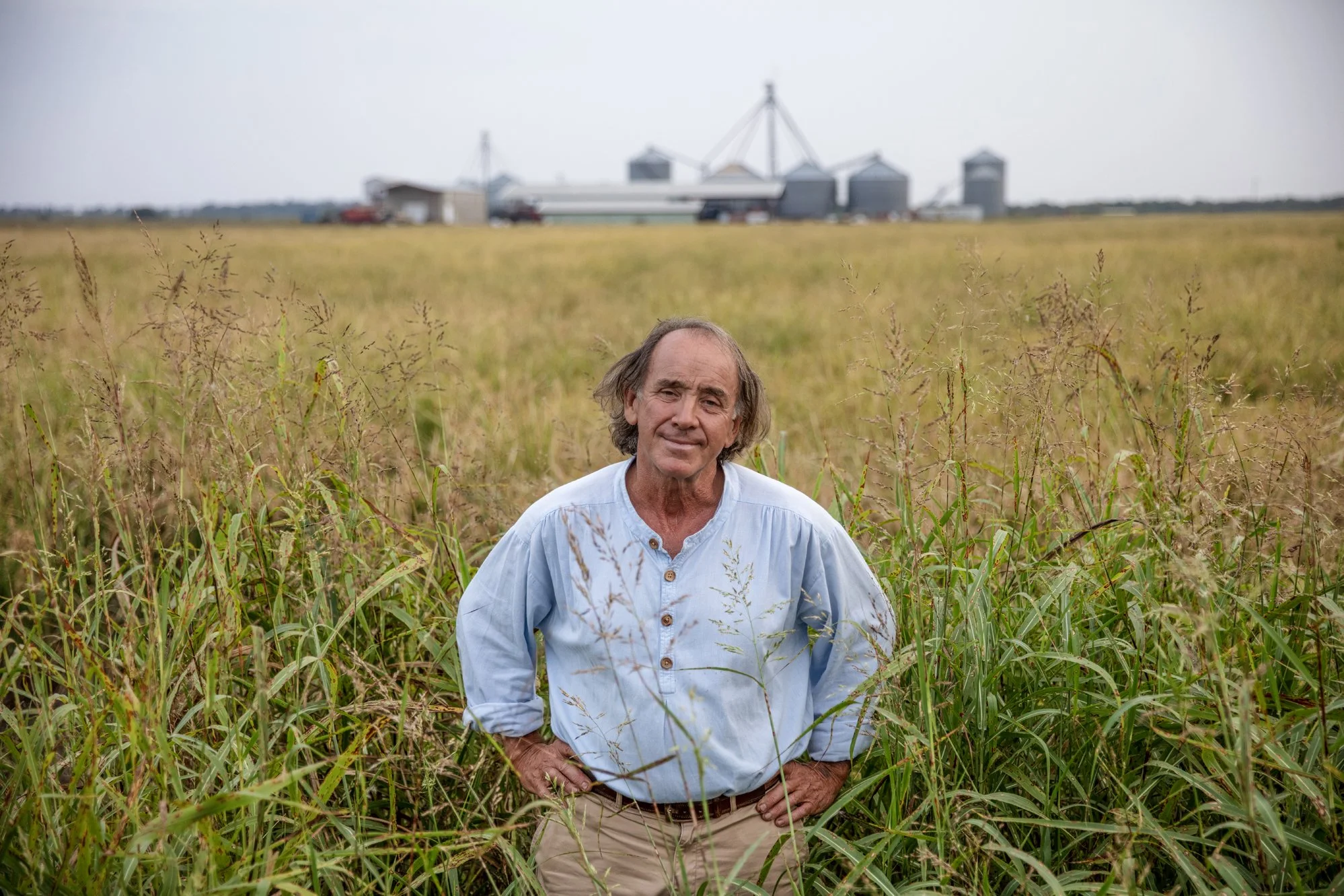
Mike Wagner rolls down his window, leans his elbow over the edge and says, “Welcome to the middle of nowhere. Which is everywhere here.” We’re on Two Brooks Road at Two Brooks Farm in the Mississippi Delta and the vastness of these fields makes you realize just how sprawling 3500 acres is. You can literally drive four miles and still be on Mike’s property. He invites us to jump into his truck to get a lay of the land.
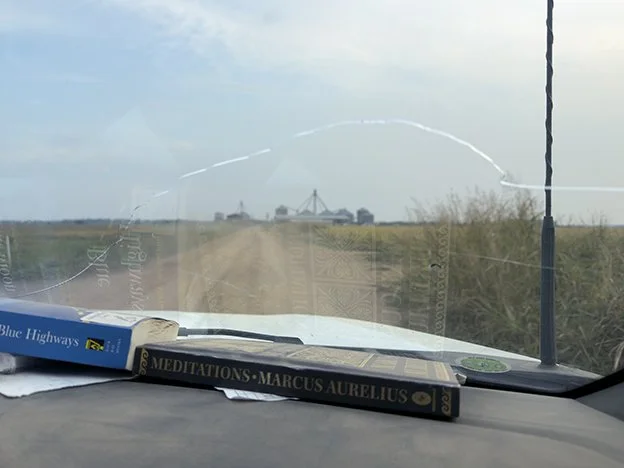
A copy of Marcus Aurelius’ Meditations sits on the dashboard of the truck and a big crack traces a line like a meandering river across the windshield. We drive past row after row of rice and soybean, willow and cane thicket. Fifteen grain bins rise out of the flat landscape, and if I squint my eyes tight enough, they look like a castle from a distance. The intense September sun filters through the dust as Mike trundles past his fields.
For years, Mike has been growing non-GMO soybeans and rice, but one of his neighbors used Dicamba, which drifted onto his land and killed off an entire field of soybean. Dicamba came on the market in 1962, not long after Mike was born, and it had been outlawed for years. Now Trump’s EPA wants it back on the market and Mike is none too pleased.
“Farmers are stupid,” he says. “They’re like crackheads. They’ll do what works until it doesn’t.”
Wisps of hair flap on Mike’s head as he drives and his rugged good looks have weathered well. He’s wearing a breezy button-down shirt and loose chinos and his eyes droop like a Saint Bernard’s. Dragonflies hover over the fields like hundreds of mini-helicopters and the air hangs humid as though August refuses to leave. We drive toward a field where one of the tractors has broken down just as the rice harvest hits its stride.
Mike has calculated his life based on the 40-hour work week, which he says would make him 186 years old. I don’t totally understand the math, but I get the gist: manpower is the measurement of a life and Mike has racked up more than his share. “All of my men are commandos,” he says, and he professes to care about them more than anyone else in the world. He claims to have forsaken most people, but this small band of singularly focused hands, heads, hearts, muscles, sweat and grist. They’re all Black, save for one, and they have arrived at his farm in various states of disrepair. Alcoholism, illness, incarceration, bankruptcy. Mike bought one of his long-time farmhands a house recently; another has bladder cancer and insists on working. Despite the fact that Mike’s son and daughter both work with him, these men keep him engaged, rooted and committed. The years are taking a toll on his workers and he’s not sure how he’ll replace them when their bodies grow too rigid to keep going. Without them, he seems at risk of decomposing like the soybean plants that surround us.
Until now, Mike has only hired local people, even though the farms around him have resorted to Latino and South African migrants to fill the labor shortage. (The South Africans, all White, made headlines when Trump declared they were fleeing persecution, even though in reality they’re seeking higher wages in a state with welcoming racial advantages.) We’ve seen the same story played out across the country, where work is plentiful but willing local-born laborers run scarce. Mike has no interest in foreign-born workers, because for him farming isn’t just about the money; it’s the relationships, the investment in the Delta and its people that make this whole undertaking worthwhile.
When his kids were young, Mike was farming 8,000 acres and he concedes that they barely saw him. He worked around the clock to grade the land to a perfect pitch so water could do what water does best: flow downhill. “Whiskey is for drinking. Water is for fighting over,” he says, putting things in perspective. He grew soybeans and rice in partnership with the land, rotating crops to replenish the soil, striving for balance between chemical interventions and the natural cycles of the earth. The challenges were relentless, he confesses.
“Every phone call was bad news. I had seven miles of trouble.”
His sweat equity allowed him to achieve the nearly impossible: he’s debt free. He claims to never have gone to the bank in all his decades of farming, a feat that’s hard to overstate. Most farmers in America live on lines of credit. They are beholden to banks, the U.S. government and John Deere, despite their claims to stubborn independence. Mike’s current operating costs are over $1.6 million and for the past few years, he has been losing money for the first time that his memory permits. “I’m scared of going broke,” he admits, and I am not clear if this is an exaggeration or genuine concern. The input costs keep going up, while the sale price for row crops keeps declining.
It doesn’t take long before Mike reveals his frustration with the current government. He’s a self-proclaimed conservative, although his definition seems centered on protecting the land and not consolidating profits. He’s convinced that Trump, whom he voted for in 2016, is leading a plot to amass power and wealth, and he notes that J.D. Vance rushed to buy distressed mutual funds. “They’re trying to break us and take all our land,” he insists. Given how thoughtful and even-keeled Mike is, I am prone to consider his conspiracy theory legitimate. We have a president who has made millions off of bitcoin, and a trade policy seemingly designed to eviscerate American businesses. What part of this doesn’t sound conspiratorial?
“We don’t have leadership,” says Mike, “we have leader-shit.” He blames the democrats too. “Just put one reasonable candidate up!” he pleads. He’s scared for the country and adds “I’m glad I’m older and I won’t live to see more of this.”
Farmers still haven’t recovered from Trump’s first term, when he flexed his tariff muscle, alienated China and exposed what a fickle trade partner the U.S. had become. Farmers took the brunt of that failed strategy, because China cultivated trade partners that bypass U.S. suppliers, destroying markets that American rice and soybean growers relied on. Mike adds that that was coupled with the declining quality of American rice, because row crop farmers in the States had turned to hybrid rice with higher yields, but the kernels break down to chicken scratch and they “taste like cardboard.” As a result, Latin America turned away from the U.S. and developed its own supply chain with help from the Chinese.
“This blustery guy comes in and I don’t blame them. Who’d want to put up with this guy?”
We’re now in Trump’s second turn at the steering wheel and the bottom has fallen out of the rice market, while soybean farmers are barely eking out a living. This year, Delta farmers have had record yields, but their crops are worth less than a year ago, and a quarter of rice farmers are expected to go out of business this year alone. Mike still has last year’s crop sitting in his silos because there’s no market. Over the past 2-3 years, he says he’s lost money for the first time in his career.
“We don’t have leadership,” says Mike, “we have leader-shit.” He blames the democrats too. “Just put one reasonable candidate up!” he pleads. He’s scared for the country and adds “I’m glad I’m older and I won’t live to see more of this.”
Mike could sell his land for $25-30 million. He figures that after tax, he’d walk away with at least $12 million.
“What would I do with $12 million? This is my life. I poured everything I had into this. I don’t eat anything but rice and beans. I just as soon go home with my workers. We’re in a big grinding machine and I don’t understand these evil people in power. I’m very conservative, but Trump’s people are radical. The system will devolve unless folks in the middle get a grip.”
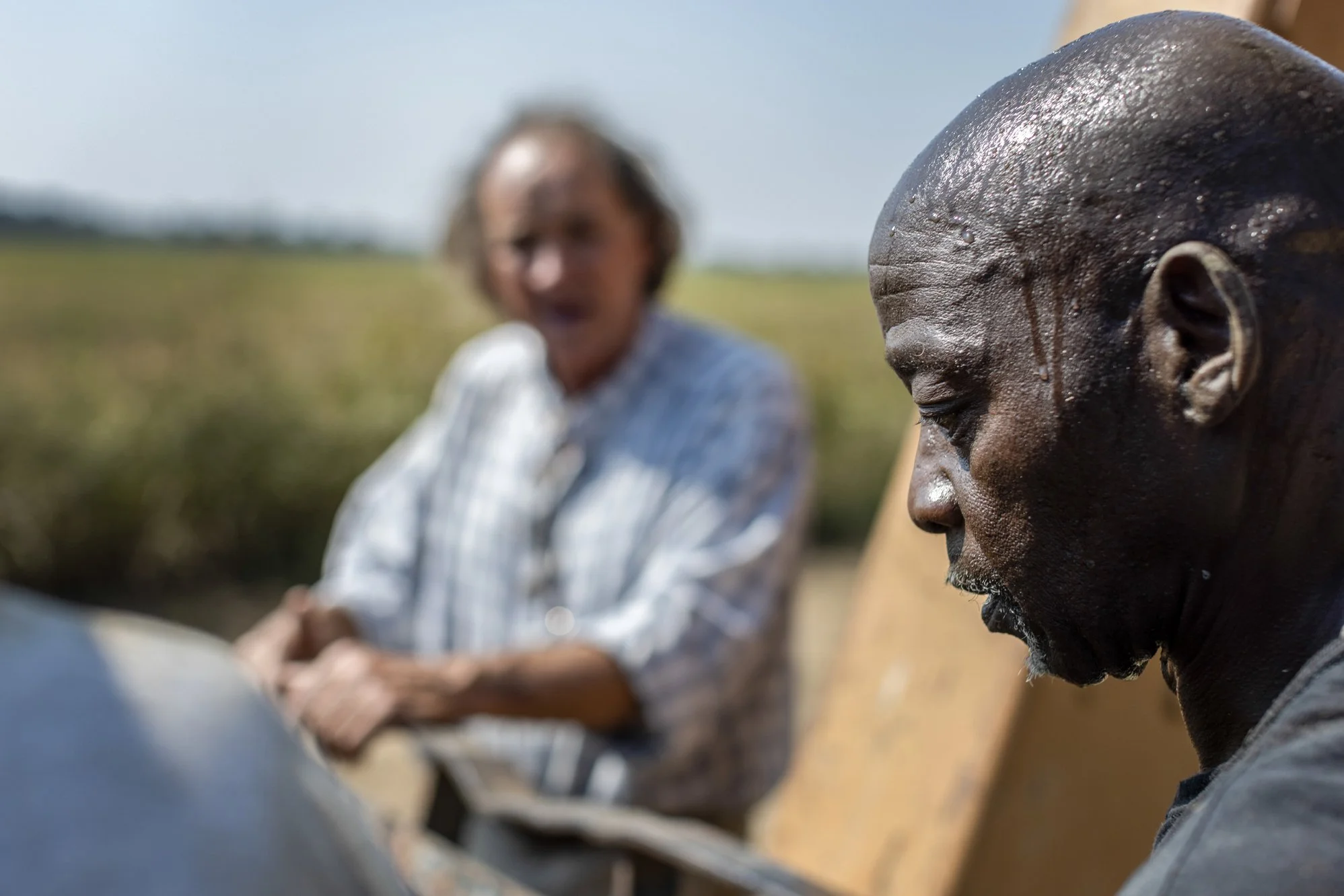
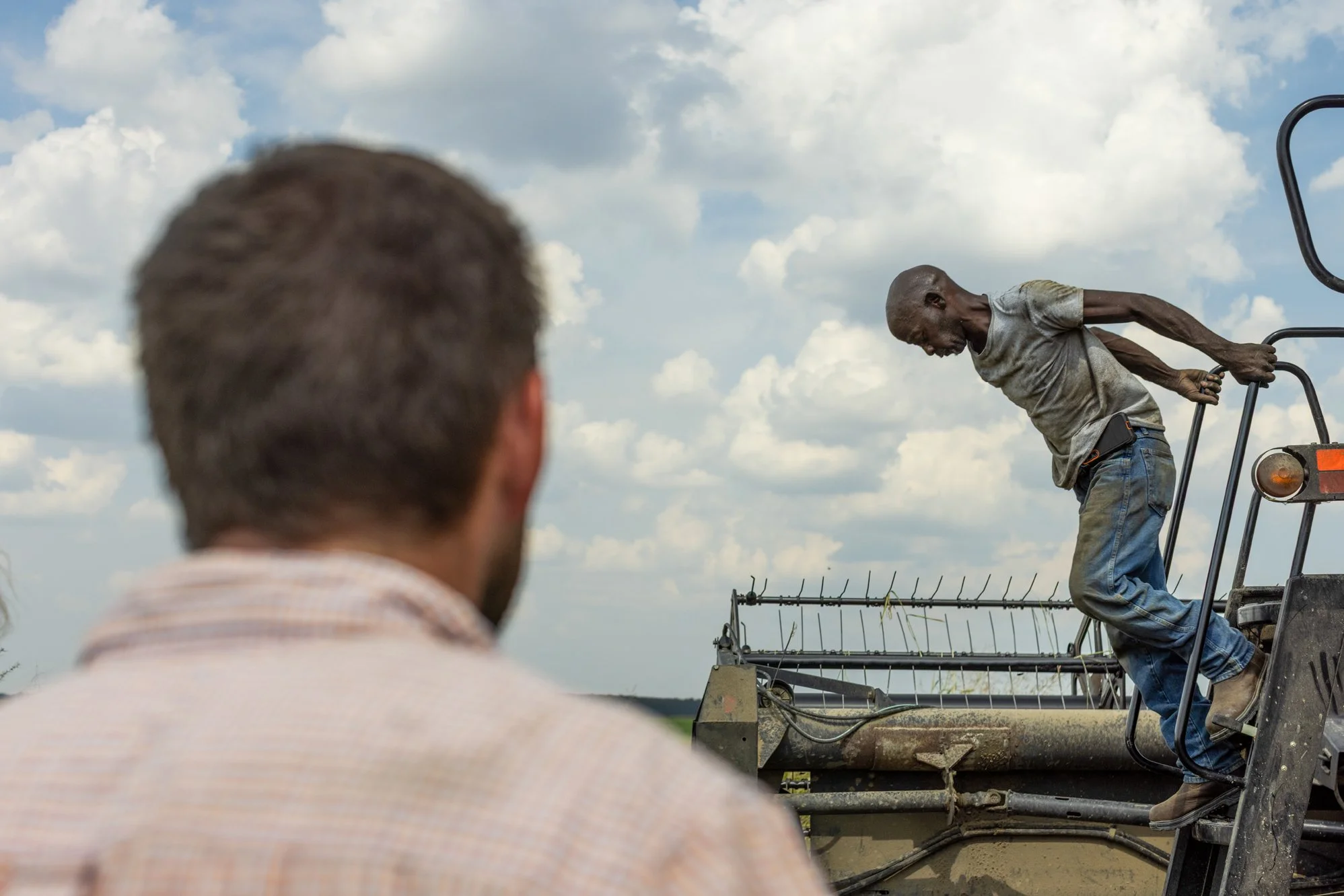
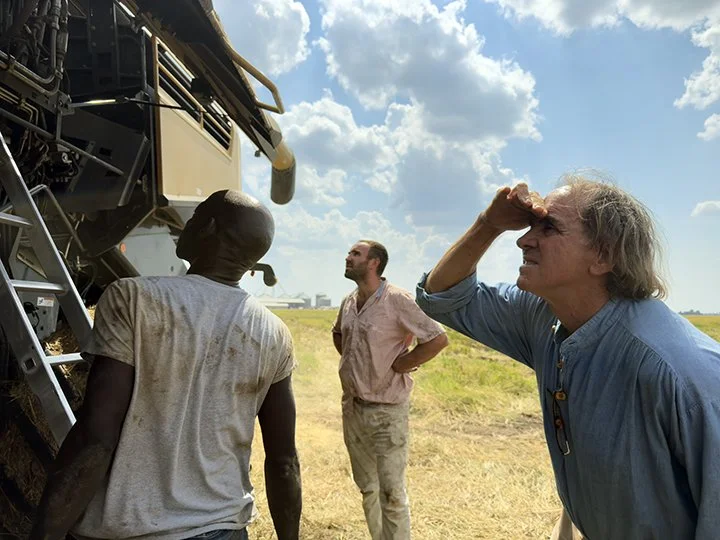
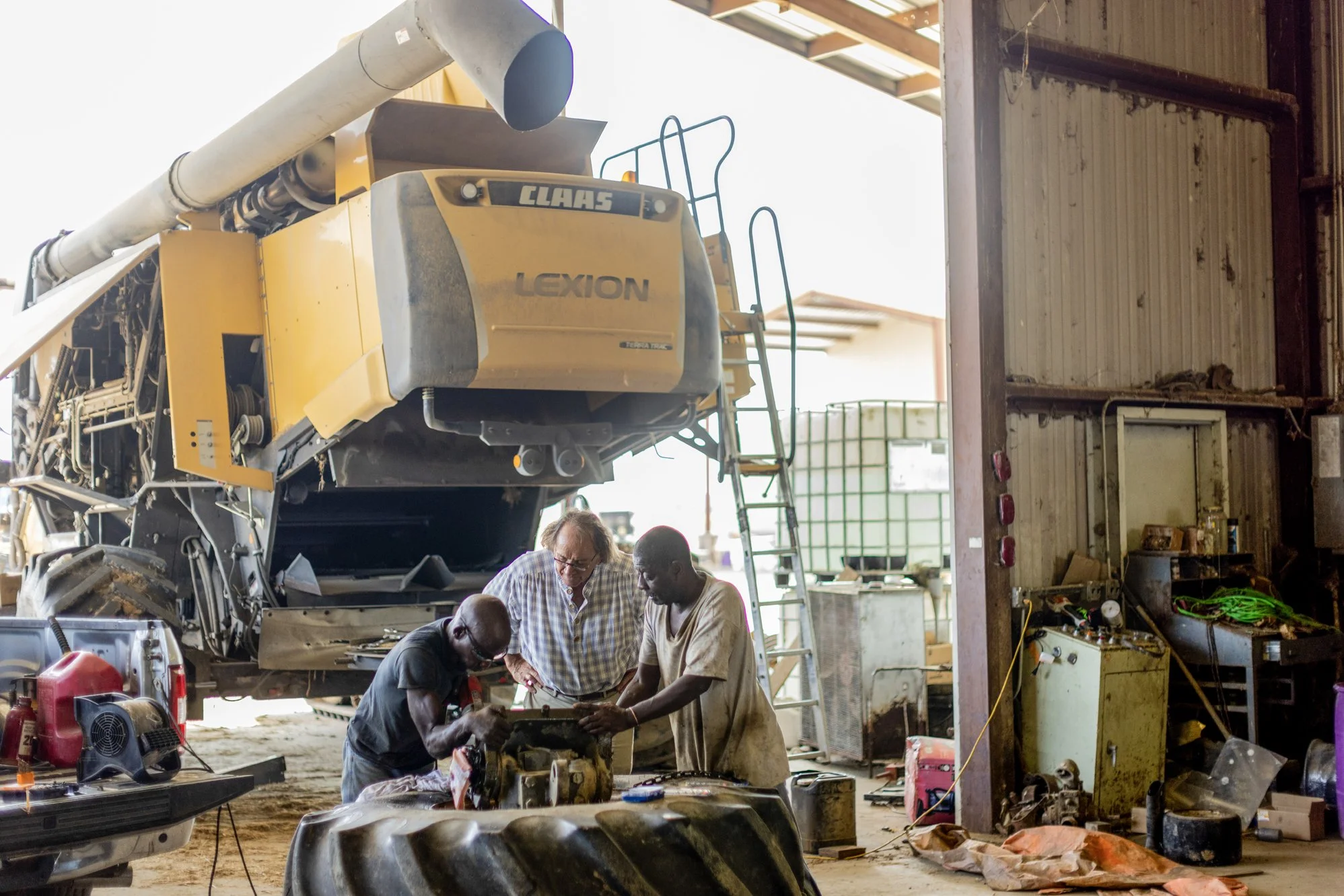
Along a dirt road between two rice fields, we spot the inert tractor looming like a T Rex skeleton. Two of Mike’s farmhands, Darryl and Buck, are trying to fix an axle that snapped when the wheel got stuck in a rut. The machine, a German-made Claas, is 13 years old. In a battle of man against machine Darryl and Buck wedge their bodies into the crevice of the wheel shaft to dislodge the wheel, which is roughly my height. Sweat trickles down their brown, bald heads as they confront the beast, wrenches gripped. In a match between ingenuity and brawn, there will be only one victor, no matter how many hours or strategies are required. The cost of replacing old equipment is exorbitant and would force Mike to borrow money, so these men will conjure every resource possible to fix this hunk of metal one more time. It’s parts are becoming more and more difficult to find, and a new bolt has to be ordered from a dealer in Columbus, Ohio.
“We’re doomed,” says Mike. That’s a three-day delay calculated into profit/loss terms. And this isn’t the only piece of equipment giving him grief today. A combine has gotten jammed a few fields over. Miles of trouble.
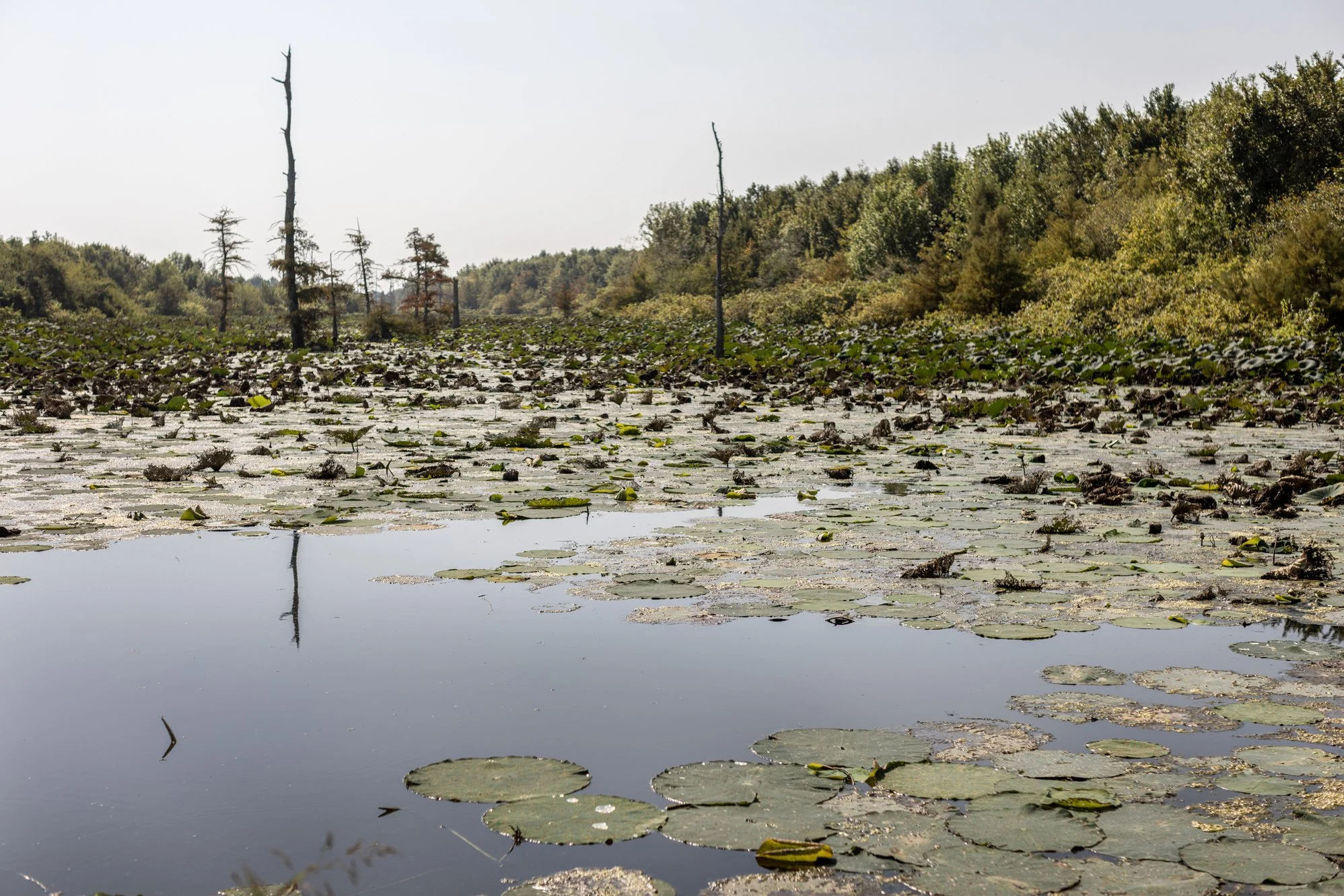
Next to the tractor, one step too far will submerge your foot into the infamous Delta mud, which has such a strong grip it’s known to suck the shoes right off your feet. Water lilies the size of serving plates fill the bayou next to us and Mike explains that the roots sometimes block his water pumps. When that happens, he strips naked and wades in to clear the debris. With mythical gravitas, he claims he’s not worried about the water moccasins. He’s got deep respect for them and says he would never kill a snake. “It’s their ecosystem, not mine.”
When we return to the car, Mike scrounges around the console, which overflows with random papers and receipts. He finds the paper scrap he wants to share with me: a prescription from Dr. Bubba for a rabies vaccine. Something bit him out in the fields and he never saw the culprit so the doctor recommended he protect himself against this vicious disease. The prescription is over a year old. Unfilled.
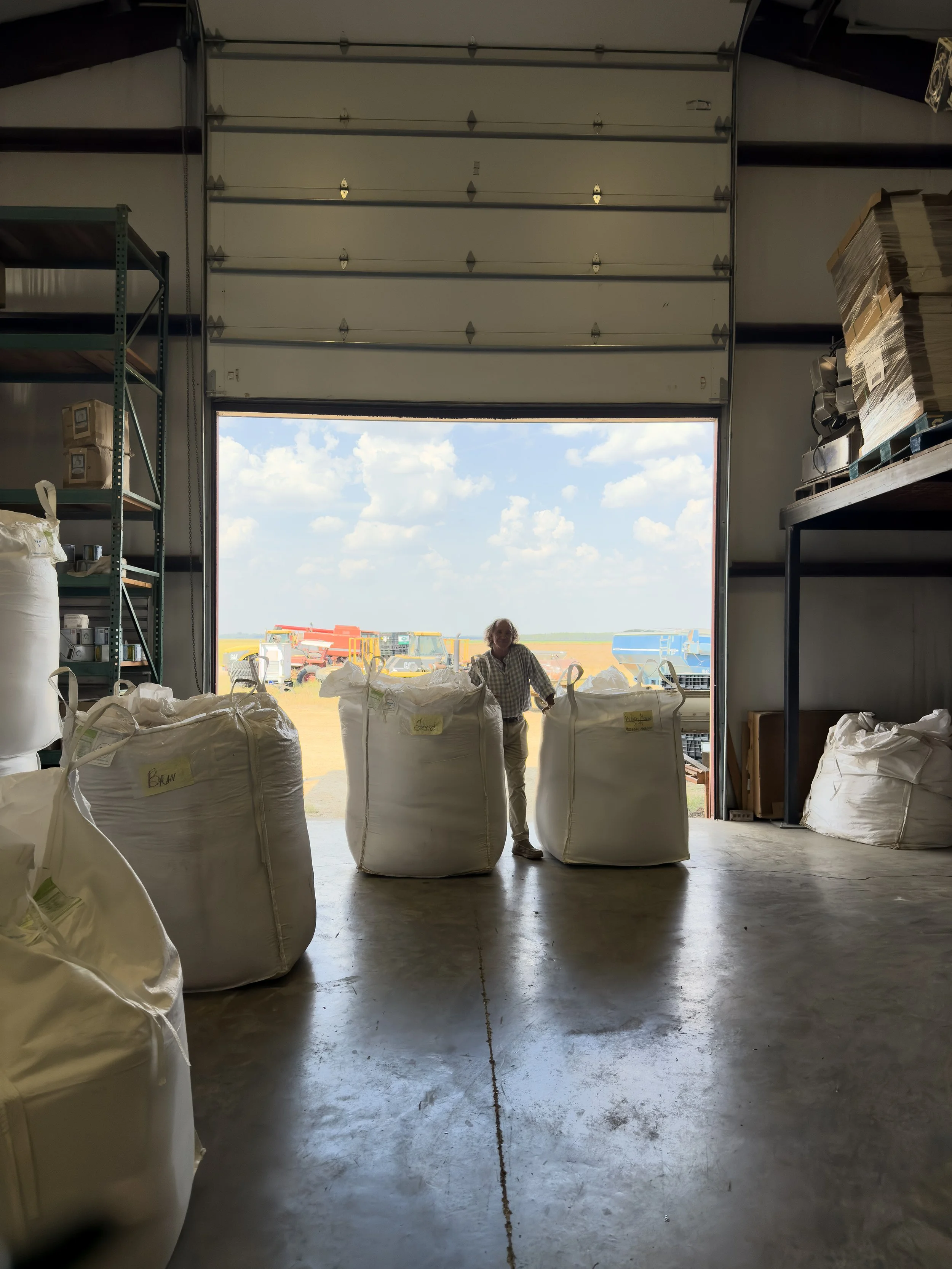
Mike leads us to the main attraction on his property, a mill where he’s able to do what no other local farmer is doing: process his own rice so he can sell direct to market. The idea came from his kids and was intended to be his retirement plan, but it hasn’t earned him a dime of profit yet. The mill looks like a cross between a barn and an airplane hangar with a 30-foot ceiling and immaculately clean, smooth concrete floors which Mike says you can lick off of. He was determined to carry a top quality product, so he even hired a rabbi to certify his products as kosher. Ultimately, he decided the ongoing $3000 rabbi fees weren’t worthwhile. Large white sacks stand sentry near a massive freight door. They’re filled with eight different varieties of rice and its by-products. Mike scoops a handful of bran and urges us to taste it. Bran, unbeknownst to us, is simply the husk of the rice, and Mike says that deer think it’s cocaine. Enthusiastic local hunters buy from him directly.
An artisan and a perfectionist, Mike searched for a manufacturer that could build a mill that would hold up in a remote setting. He visited one run by some Mennonites in Belize, and then ordered what they had from a manufacturer in Brazil. Two Brooks Farms has a state-of-the-art mill that can process 1.3 million pounds of rice per year. Their varieties include arborio, red rice from Africa, and Missimati, which they were forced to brand after learning that “basmati” was protected like Champagne. The trademark refers only to long-grain rice produced in particular regions of India and Pakistan. Two Brooks now also produces Missisushi for starchy rice lovers, and I am starting to see the beautiful poetry of bougie artisanal rice produced in the muddy Mississippi Delta by a rugged farmer with refined gourmet tastes.
We’ve landed in an alternate reality, far removed from the version of America we thought we knew, and it has only been made visible because we’ve taken the time to stand in the presence of a person in a place far removed from our own. The perfect symmetry of our lives has been made visible.
Mike insists we take a few bags of rice to sample and I covet them like precious truffles. Each kernel holds a fraction of the labor, the investment, the sacrifice, the dirt, the air and water that brought it into being. I have a newfound appreciation for what went into this most common of commodities.
The conveyer belts of the mill keep shuffling rice along. Mike’s daughter, sheathed in rice flour, tries to adjust the machine that fills the sacks. Two Brooks is having trouble expanding its market beyond some well-known chefs in places like New Orleans, and it seems Mike’s daughter, who handles the marketing end of the business, has grown frustrated and disenchanted. His son has started to farm some of his own acres. Mike is wondering if the mill was just an itch he needed to scratch, and now the itch is subsiding. For a man sitting on $25 million worth of land, Mike is filled with deep questions masquerading as regrets. He seems grateful to have two strangers with open ears to receive his ponderings.
It is a shame for the soul to be first to give way in this life, when your body does not give way.
Marcus Aurelius